
Be sure to visit our Behavior Resources webpage and Discipline Resources webpage for additional information.
What is a Manifestation Determination Review or MDR?
Students with disabilities have a right to a formal review of their behavior before long-term suspensions or expulsions. This is called a Manifestation Determination Review (MDR).
If a student with a disability has been removed for more than ten days (ten school days in a row, or ten school days if days of removals show a pattern of behavior when added together), a MDR must be held within 10 school days.
The purpose of this review is to determine whether or not the child’s behavior is linked to their disability, or because the IEP was not fully implemented. This is an important meeting, be aware that the district will proceed without the parent in attendance.
What happens during MDR?
During the MDR meeting, the team will review and consider information in the student’s file including student’s IEP, course grades, progress reports, disciplinary record anecdotal notes, etc. Information from the parent is also reviewed. This review provides a picture of the whole child. The team must determine whether the conduct in question was a manifestation of the student’s disability. MDR decisions should be made through consensus rather than voting. The district should keep detailed documentation of all considerations.
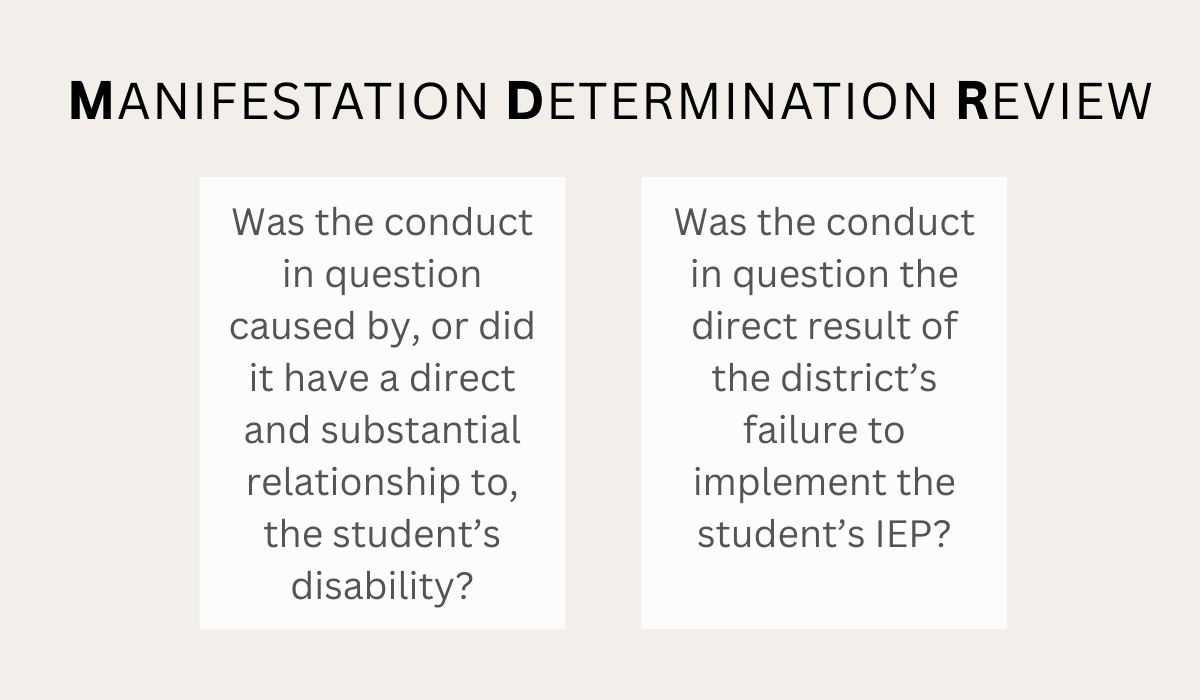
The MDR is answering two questions:
1. Was the conduct in question caused by, or did it have a direct and substantial relationship to, the student’s disability?
2. Was the conduct in question the direct result of the district’s failure to implement the student’s IEP?
-
- Were the programs and services described in the IEP provided as written? If yes,then no further discussion is needed.
- If no, did the failure to implement the IEP result in the behavior in questions.
An answer of yes to one of the above questions means the conduct in question was a manifestation of the student’s disability. The district must then take immediate steps to ensure all the following discipline protections occur:
1. The student returns to the prior placement, unless:
- the parent and district agree on a change of placement as part of a modification of the behavior intervention plan (BIP)
- the conduct in question involved weapons, drugs, or serious bodily injury.
2. The IEP team must conduct a functional behavior assessment (FBA) and create a BIP, unless:
- the student already has an FBA prior to the behavior which resulted in a change of placement; and
- the student already has a BIP, in which case the team must review the BIP and revise as necessary.
3. When the conduct in question is a result of the IEP team’s failure to implement the IEP, the district must remedy deficiencies of IEP implementation.
If the answer to both questions is no, the conduct in question is determined not to be a manifestation of the student’s disability. The district may apply the same discipline procedures in the same manner and for the same duration, as are applied to nondisabled students. The district must:
1. Provide educational services so the student can continue to participate in the general education curriculum, although in another setting, and to progress toward meeting the goals in their IEP.
2. Consider an FBA, when one has not already been completed, and a BIP.
3. The district may need to develop an IEP for an interim alternative education placement where educational services will be provided in an interim alternate education setting in order to allow the student to participate in the general education curriculum and progress toward meeting IEP goals.
- Responding to and Counting Disciplinary Removals MDE
- Determining a Change of Placement MDE
- Conducting a Manifestation Determination Review MDE
- Manifestation Determination Review Form MDE
- Manifestation Determination CPIR
What is an Interim Alternative Educational Setting?
If student is removed from their educational placement for more than 10 school days (consecutive or removals that add up to 10 school days and show a pattern of behavior), services must be provided to allow the student to progress toward meeting IEP goals and participate in the general education curriculum (although in another setting).
Choosing an Interim Alternative Educational Setting (IAES) depends on individual circumstances. This could be home-based instruction delivered through a virtual, in-person, or hybrid approach. The appropriate IAES allows the student to continue to participate in the general education curriculum and progress toward meeting the goals set out in the student’s IEP. Parents are part of the IEP team making the placement decision about the IAES. IF a parent disagrees with an IEP team decision, dispute resolutions are available.
The IAES includes a Functional Behavioral Assessment (FBA), and behavioral intervention services and modifications to address the behavior so that it does not happen again.
Questions parents can ask during IAES discussion
- What options are being considered for an IAES?
- What criteria is used to determine appropriateness for the student in each setting being discussed?
- Is this the most appropriate, least restrictive environment for the student?
- How will instruction be provided and who will provide it?
- What special education and related services will be provided to the student?
- How much time will the student receive instruction?
- How will progress towards IEP goals be measured?
- How often will progress updates be communicated with me?
- Is staff training on how to support the student’s behavior needed?
- What is the plan for the student to return to the school setting?
- Who is the contact person for questions or concerns?
What if I disagree with the MDR decision?
If the team cannot agree on whether the student’s behavior was or was not a manifestation of the disability, the public agency must make the determination and provide the parent with prior written notice.
A parent can sign the MDR document in disagreement, and has the right to exercise procedural safeguards by requesting mediation and/or an expedited due process hearing to resolve a disagreement about the manifestation determination. A parent also has the right to file a State complaint alleging a violation of Part B related to the manifestation determination.
- Appeal of MDR
- Child’s Placement during Appeals Process
- Special Education Due Process Complaint Procedures MDE procedures regarding special education administrative due process hearings
- MAF Dispute Resources More on dispute resolution, State complaints, due process
Find help:
- Contact Michigan Alliance for Families 1-800-552-4821
- Michigan Department of Education Help Line 1-888-320-8384
- Michigan Legal Help
- Disability Rights Michigan 1-800-288-5923