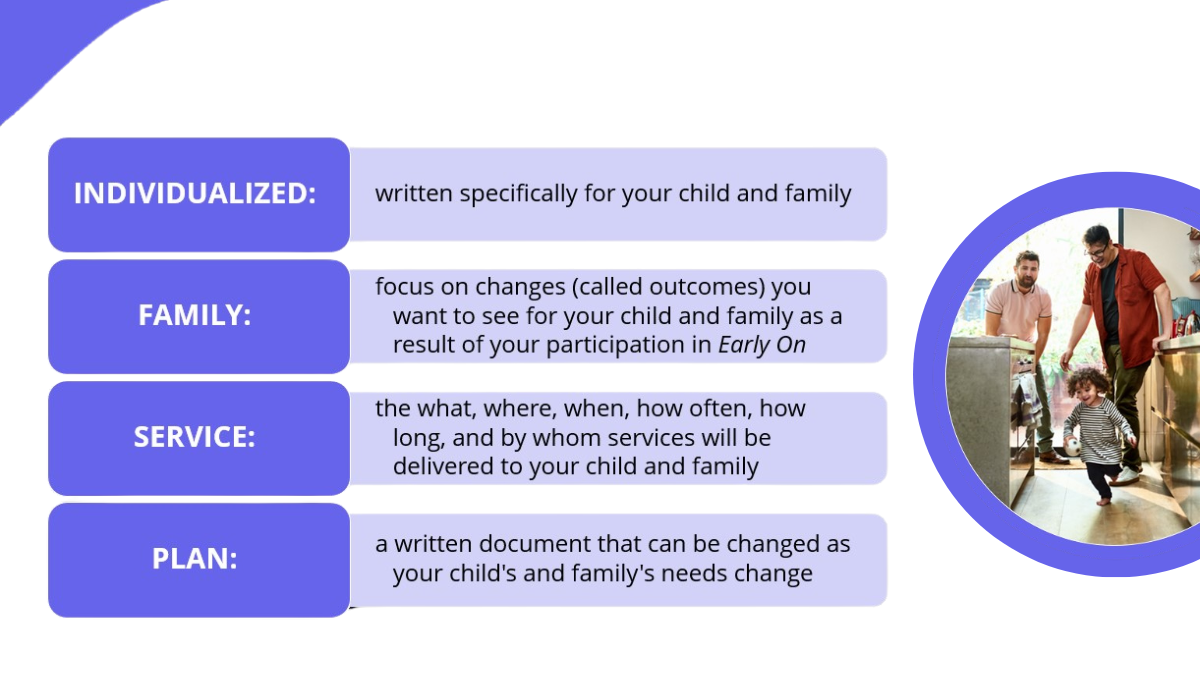
An Individualized Family Service Plan (IFSP) is a written plan for infants and toddlers from birth to age three who qualify for Early On services. The IFSP contains the child’s developmental strengths and needs, identifies family priorities and areas of concern, and specifies the services and supports that will be provided to support the family and the child. IFSPs are family-centered, developed collaboratively with the family, recognizing that supporting the family is key to supporting the child’s development.
IFSP Team
The IFSP is developed by the IFSP team, including the parents, the service coordinator, and service providers. Service providers provide a direct service to a family or child. This could be a Speech Therapist, Occupational Therapist, Physical Therapist, etc. The IFSP team members and their involvement will vary depending on the family’s priorities and the child’s individual needs.
IFSP Natural Environments
IDEA states that, to the maximum extent appropriate, children must receive services in a setting that is natural for an infant or toddler of the same age who does not have a developmental delay or disability. This is known as the Natural Environments and may include the home or any place where the child regularly spends time, such as childcare centers, playgrounds, libraries, or other community locations. Since every family’s routines and needs are unique, a child’s natural environment may look different from one family to another.
IFSP Required Components
Michigan requires certain elements to be part of an IFSP but there is no single standardized IFSP form. Your service coordinator should provide you with information that explains the Early On process, key terms, IFSP development, your legal protections and more.
Parts of the IFSP include:
- Child & Family Information
- Description of Present Levels
- Measurable Outcomes
- Services
- Transition Planning
IFSP Meetings
To prepare for an IFSP meeting, the service coordinator will talk with the family about which team members may attend the meeting, what the agenda will be, and the meeting time and location. The coordinator will notify all team members in writing. This meeting notice should be given early enough before the meeting date to ensure you can attend. After each IFSP meeting, you must be given a copy of the new IFSP.
Frequent review of the IFSP assists in guiding future plans, specific actions, and discussions about old and new priorities. The IFSP can be revised any time there is a need. If things are not working out or there is a new need, you should contact your service coordinator to talk about your concerns. Team members can also raise a new concern or need, but the parent determines whether the new concern/need becomes an IFSP priority. If the concern/need is a priority for the family, then a change to the IFSP must be made.
-
Initial IFSP Meeting With your written consent, the initial IFSP meeting occurs, and the services documented in the IFSP are provided to the child, in the manner described, within calendar 30 days from the date it is signed IFSP.
-
Periodic Review of the IFSP The purpose of a periodic review is to assess the progress being made toward the outcomes identified in the IFSP and determine whether modifications to the outcomes or services are needed. These reviews must occur every six months, or sooner if you request.
-
Annual Meeting to Evaluate the IFSP The purpose of the Annual Meeting is to evaluate and, if needed, revise the IFSP, focusing on the plan itself rather than conducting a new evaluation of the child. This meeting takes place once a year, is more formal than a Periodic Review, and must be held face-to-face.
Disagreements
An important right for parents is the ability to disagree. Maybe you’re not being heard, or the plan isn’t being followed, or you don’t agree with decisions that have been made. Parents have Dispute resolution options available to them.